
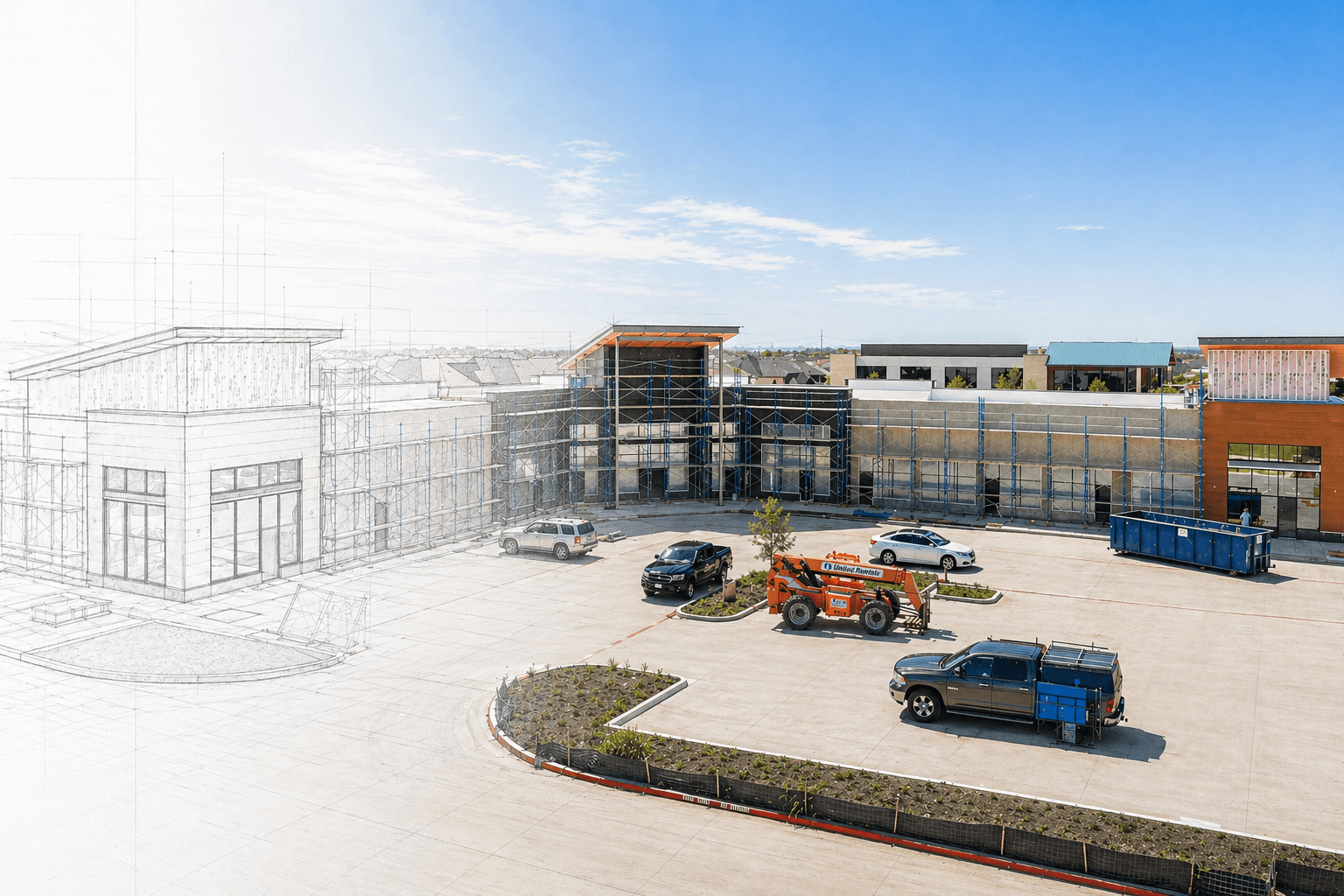

Infrastructure Costs in Texas Developments: What Most Investors Underestimate
The utilities and drainage, permitting, and site preparation are some of the infrastructure costs many investors underestimate in Texas developments.
Texas is booming, and everyone knows it. New rooftops, new business parks, and new master-planned communities are popping up from the Dallas-Fort Worth Metroplex to the outskirts of Austin and San Antonio.
It's easy to look at that growth and assume the hardest part of investing is simply finding the right parcel of land.
However, that assumption is exactly where most investors get burned. The real cost of a Texas development rarely lives in the price of the dirt.
It lives underground, in the pipes, wires, and roads that have to exist before a single foundation is poured.
Moreover, this "horizontal infrastructure" - water lines, sewer connections, drainage systems, and roadways - is where budgets quietly spiral and timelines stretch far beyond what anyone expected.
Let's break down exactly where the money disappears, why it happens so consistently, and what investors can do to stay ahead of it, including how the right construction partner changes the equation entirely.
The Land Price Is Just the Entry Fee
First, let's talk numbers.
Texas development-stage land is currently averaging somewhere around $10,200 per acre statewide, though that figure swings wildly depending on the region and how close the parcel is to existing utility infrastructure.
In fast-growing counties like Williamson and Comal, land that's already zoned and close to services can sell for four to seven times the price of comparable agricultural land nearby.
That price gap isn't random. It's a direct reflection of infrastructure access. Land near existing water, sewer, and road networks commands a premium precisely because someone else already absorbed the cost of building that infrastructure.
Land without it looks like a bargain on paper, but that's usually where investors underestimate what comes next.
You can also read: 10 Steps to Evaluate a Raw Land Deal Before You Close in Texas.
Where the Real Costs Hide: Horizontal Infrastructure
Once a parcel is purchased, the actual work of "developing" it begins, and this is where most first-time or out-of-state investors get their numbers wrong.
According to land development cost breakdowns for 2026, raw land development in Texas typically runs between $50,000 and $200,000 per acre once you account for the full scope of work:
Site preparation (clearing, grading, demolition): roughly $5,000-$20,000 per acre
Utility installation (water, sewer, electric, gas): roughly $15,000-$50,000 per acre
Roads and drainage infrastructure: roughly $10,000-$40,000 per acre
Engineering, permitting, and soft costs: often $10,000-$100,000 depending on complexity
Add it up, and infrastructure development can easily represent 20% to 40% of a project's total investment before a single unit is sold or leased.
Yet in early-stage pro formas, these costs are often treated as a rounding error rather than a core line item.
That's a costly mistake, and it's exactly why experienced developers bring in a general contractor in Texas with land development expertise from day one, rather than after the numbers stop adding up.
You can also read: How Civil Engineering & Site Planning Impact Project ROI in Texas.
Impact Fees: The Line Item Everyone Forgets
Beyond the physical cost of building infrastructure, Texas municipalities also charge impact fees, which are one-time charges assessed on new development to help cities recover the cost of expanding water, sewer, and road capacity to serve that growth.
Under Chapter 395 of the Texas Local Government Code, cities are required to calculate these fees based on land use assumptions and expected population growth, and the fees can't legally exceed the actual cost of providing the service.
Here's the part that trips people up: these fees vary enormously by city, and they're rising.
In fast-growing suburbs, combined water, sewer, and roadway impact fees can range from a few thousand dollars per unit to well over $20,000 per acre in areas with aggressive infrastructure expansion.
Some cities have raised their impact fee schedules by more than 200% in a single adjustment cycle to keep pace with capital costs. If your budget was built using fee schedules from even two years ago, there's a good chance it's already outdated.
The practical takeaway here is simple: never assume last year's fee schedule still applies.
Impact fees should be verified directly with the city or utility district before finalizing any pro forma, not pulled from a template or a broker's rough estimate.
MUDs, PIDs, and the Financing Layer Most Investors Never Plan For
For larger developments, especially those on the edge of a city's existing utility footprint, infrastructure costs often get wrapped into a Municipal Utility District (MUD) or Public Improvement District (PID).
These special districts let developers finance water, wastewater, drainage, and roadway infrastructure through bonds rather than paying entirely out of pocket upfront, but forming one is its own regulatory process, involving feasibility analysis, petitions, board elections, and coordination with the Texas Commission on Environmental Quality.
This is where a lot of investors get stuck. MUD and PID formation touches legal structuring, bond financing strategy, and infrastructure engineering all at once, and getting any one piece wrong can delay a project by months.
It's also exactly the kind of work that benefits from a partner who handles feasibility, district formation, and infrastructure design under one roof instead of coordinating five separate consultants.
You can also read: MUD, TIRZ & Incentives: 5 Things Developers Should Know in Texas.
The Overrun Problem: Why Budgets Rarely Hold
Even with accurate upfront estimates, infrastructure projects have a well-documented tendency to run over budget.
Industry-wide research consistently shows that roughly 9 out of 10 construction projects experience cost overruns, with average overruns landing somewhere between 15% and 28% of the original budget.
Large infrastructure projects tend to fare even worse, frequently running up to 80% over budget and 20% behind schedule.
Why does this happen so consistently? A few recurring culprits show up again and again:
Estimating errors account for roughly a third of all overruns, often because early estimates don't reflect actual soil conditions, utility tie-in complexity, or current material pricing.
Design changes made mid-project ripple through the schedule and budget simultaneously, since utility and road work is sequential by nature.
Permitting delays at the municipal level can push a project's timeline out by months, during which carrying costs on land and financing continue to accrue.
For investors, the lesson isn't that overruns are avoidable entirely. They're not. The lesson is that a serious infrastructure budget needs a real contingency, not a token one.
Many lenders now recommend building in at least a 20% contingency on infrastructure costs specifically, and given how often "typical" overruns exceed that figure, even 20% should be treated as a floor rather than a ceiling.
You can also read: 8 Ways to Deliver a Commercial Building with Zero Change Orders.
How TX Sparks Construction Helps Investors Control These Costs
This is exactly the gap TX Sparks Construction was built to close.
As a Texas-based general contractor working across land feasibility, land entitlement, MUD & PID services, and more, it manages the entire lifecycle of a development under one roof, rather than leaving investors to stitch together separate consultants for each phase.
That matters most in the infrastructure phase specifically.
TX Sparks Construction's MUD & PID services cover feasibility analysis, district formation and board elections, bond financing strategy, and integrated engineering for water, wastewater, drainage, and roadway systems, which are the exact cost centers this article has walked through.
Rather than discovering a utility tie-in overrun three months after it happened, investors working with TX Sparks Construction get that oversight built into the process from the feasibility stage forward.
Moreover, backing this up is TX Sparks Construction's internally developed platform, SuperConstruct, which gives clients real-time visibility into budget tracking, expense management, project schedules, documentation, and inspections throughout a project's lifecycle.
Every construction pay application, change order, and daily log lives in one system with a full audit trail, which is precisely the kind of early-warning visibility that keeps a 15% overrun from quietly becoming a 40% one.
On top of that, TX Sparks Construction brings over 10 years of experience, more than 55 completed projects, and a track record of 100% on-time completion to Texas commercial and residential developments, including recent ground-up work like Lexington Square, a 41,560-square-foot commercial project in Frisco.
You can also read: 8-Step Ground-Up Construction Process in Texas.
What Smart Investors Should Actually Do
Rather than trying to memorize every fee schedule in every Texas municipality, the more useful shift is a change in process.
Before committing capital to a Texas development, it's worth taking these steps:
Verify impact fees directly with the city or MUD rather than relying on outdated estimates, since Texas fee schedules are legally required to be reassessed every five years and often change sooner in high-growth areas.
Budget infrastructure as its own line item, representing 20-40% of total project cost, not a footnote buried inside "site work."
Build in a real contingency, ideally 20% or more on infrastructure specifically, given how frequently that threshold gets crossed.
Bring in a general contractor with land development and MUD/PID experience early, ideally at the feasibility stage, so infrastructure planning and financing are built into the project rather than bolted on after problems surface.
Ask how costs and permits are tracked, since projects managed with real-time oversight tools are far better positioned to catch overruns early rather than after the damage is done.
You can also read: Starting a Commercial Build in DFW: 8 Things You Should Know.
Conclusion
Texas's growth story is real, and the opportunity for investors remains strong. But the developments that succeed aren't necessarily the ones with the cheapest land.
They're the ones where infrastructure costs were treated with the seriousness they deserve from day one.
Water lines, impact fees, MUD formation, and road work don't make for exciting conversation at the investor pitch, but they're exactly what determines whether a project stays on budget or becomes a cautionary tale.
If you're evaluating a Texas development and want a clearer picture of what the infrastructure side will actually cost, TX Sparks Construction can help.
Book a free consultation with TX Sparks Construction or call (469) 598-2558 to talk through your project before you close on the land.
FAQs: Frequently Asked Questions
1. What percentage of a Texas development budget typically goes toward infrastructure?
Infrastructure, meaning site preparation, utility installation, roads, drainage, and related engineering and permitting, typically represents 20% to 40% of a project's total investment. This is often underestimated in early pro formas because it's treated as part of "site work" rather than its own budget category.
2. Are Texas impact fees the same in every city?
No. Impact fees are set individually by each city or utility district under Chapter 395 of the Texas Local Government Code, so they vary significantly by location and by the type of infrastructure being charged for (water, sewer, roads, or drainage). Fee schedules are required to be reassessed every five years, and some cities have raised fees by more than 200% in a single adjustment cycle, so it's important to verify current rates directly rather than relying on outdated estimates.
3. What's the difference between a MUD and a PID?
Both are special districts used in Texas to finance infrastructure like water, wastewater, drainage, and roads through bonds rather than requiring the developer to pay entirely out of pocket upfront. A Municipal Utility District (MUD) is generally focused on utility infrastructure and operates with its own governing board, while a Public Improvement District (PID) can fund a broader range of public improvements and is typically overseen by the city. Choosing between them, or forming one, involves feasibility analysis, legal structuring, and coordination with agencies like the Texas Commission on Environmental Quality.
4. How much contingency should investors budget for infrastructure cost overruns?
Most lenders recommend a minimum 20% contingency on infrastructure costs specifically, given how frequently projects exceed that threshold. Industry data shows roughly 9 out of 10 construction projects experience some level of cost overrun, with typical overruns landing between 15% and 28%, and larger infrastructure projects sometimes running significantly higher.
5. When should a developer bring in a general contractor for a Texas development?
Ideally, at the feasibility stage, before land is even closed on. Bringing in a contractor with land development and MUD/PID experience early allows infrastructure costs, impact fees, and financing strategy to be built into the project from the start, rather than discovered mid-construction when changes are far more expensive to make.
Disclaimer: This article is provided for general educational and informational purposes only and does not constitute professional, legal, financial, or engineering advice. While TX Sparks Construction makes every effort to keep this content accurate and current, we make no warranties as to its completeness, accuracy, or reliability. Construction codes, regulations, and requirements vary by location and project and are subject to change. Any action you take based on this information is strictly at your own risk. For guidance specific to your project, please consult a qualified professional or contact our team directly.