
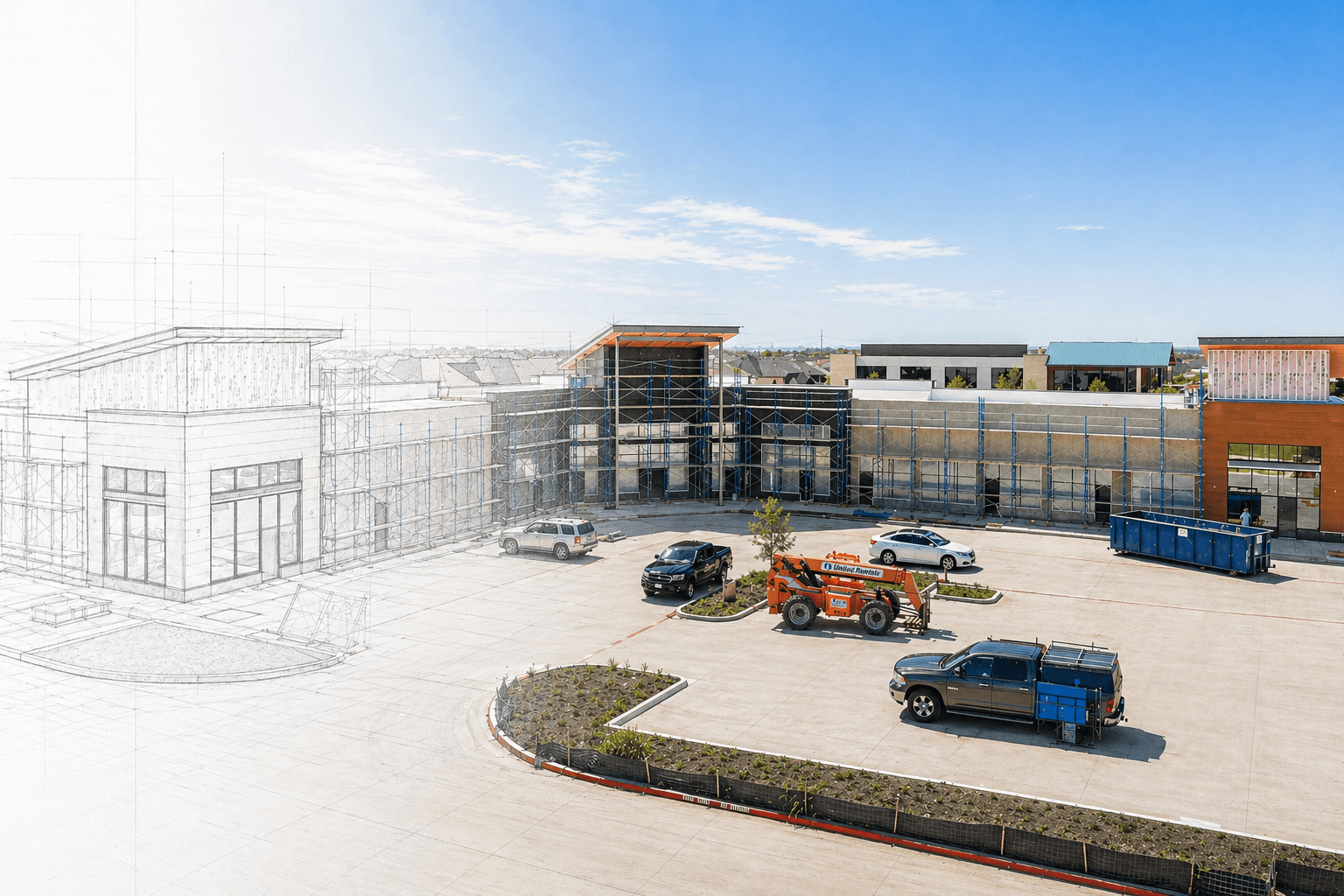

Commercial Construction Insurance and Liability in Texas: What You Should Know
Learn about commercial construction insurance and liability in Texas, including general liability, compensation, risks, and coverage requirements.
If you're running a construction business in Texas, you already know the risks aren't hypothetical. A crane operator misjudges a swing radius.
A subcontractor leaves a trench unbarricaded overnight. A steel beam shifts during a wind event and damages the building next door.
Any one of these moments can turn a profitable project into a legal and financial nightmare, unless you've planned for it in advance.
That's where commercial construction insurance and liability coverage come in. And in Texas, the rules are a little different than what you'll find in most other states.
Understanding those differences isn't just a compliance exercise; it's what stands between your business and a lawsuit that could shut you down for good.
It's also, increasingly, what separates the contractors clients trust with a multimillion-dollar build from the ones they pass over.
Firms like TX Sparks Construction, a Texas-based general contractor built around exactly this kind of risk discipline, are a good example of what that looks like in practice.
Let's walk through what you actually need to know.
Texas Commercial Construction Insurance Laws: Why the Rules Are Different
Here's something that catches a lot of contractors off guard: Texas doesn't require a state license to operate as a general contractor.
However, that doesn't mean you're free of oversight; many cities and municipalities, including Dallas, Houston, San Antonio, and Austin, layer on their own registration and insurance rules on top of state law.
Even more surprising to newcomers: Texas is the only state in the country that doesn't require private employers to carry workers' compensation insurance.
For most Texas businesses, the only insurance the state actually mandates is commercial auto, and even then only if you own a vehicle. Workers' comp becomes mandatory only when you're working on government or public projects in the state.
At first glance, that might sound like a loophole worth exploiting. In practice, it rarely is.
Because the legal floor is so low, general contractors in Texas have learned to protect themselves contractually. Most GCs now require every subcontractor on their job to carry workers' compensation, regardless of what state law technically demands.
If you skip it, you're not just exposing your crew; you're exposing your business to an uninsured claim that a client or lender will almost certainly balk at.
The takeaway: legal minimums and business reality are two different things in Texas. Smart contractors build their coverage around the second one.
You can also read: Starting a Commercial Build in DFW: 8 Things You Should Know.
Commercial Construction Insurance Coverage Types Texas Contractors Need
While the state itself stays hands-off, your clients, lenders, and project owners won't be nearly as relaxed.
Most commercial contracts spell out specific insurance requirements before you're even allowed to break ground. Here's what typically shows up on that list.
General Liability (GL) Insurance for Texas Contractors
This is your foundation. It covers third-party bodily injury, property damage, and the legal costs that come with defending those claims.
A $1,000,000 per-occurrence limit with a $2,000,000 aggregate has become the standard baseline that private owners and municipalities expect, and some ask for even more depending on project size.
It's worth noting, though, that a standard GL policy has real gaps; it generally won't respond to intentional damage or claims tied to professional negligence, which is why larger firms layer additional coverage on top of it.
You can also read: 8 Ways to Deliver a Commercial Building with Zero Change Orders.
Workers' Compensation and Employers' Liability Insurance in Texas
Even though Texas doesn't force your hand here, nearly every serious commercial project will.
Public agencies typically require coverage that meets the statutory benefits laid out in the Texas Workers' Compensation Act, and many contracts add specific employers' liability minimums on top, often in the range of $100,000 per injury, $300,000 per occurrence, and $100,000 for occupational disease.
Commercial Auto Liability Coverage
If a vehicle, yours or a sub's, ever touches your jobsite, this coverage matters.
An uninsured subcontractor's accident on the way to or from your project can create a claim that lands squarely on your desk, even if you weren't behind the wheel.
Builder's Risk Insurance for Construction Projects
This protects the structure itself while it's under construction, covering the completed value of the project against fire, storms, theft, and other covered perils until the work is finished and handed over.
Umbrella and Excess Liability Insurance
Once your underlying policies max out, umbrella coverage picks up where they leave off.
A $1,000,000 umbrella that follows form over your auto, general liability, and employers' liability coverage is a common requirement on larger municipal and commercial contracts.
Professional Liability Insurance for Design-Build Contractors
If your firm handles construction management, in-house design, or delegated design work, general liability won't protect you here.
Professional liability fills that gap, along with related add-ons like pollution liability for jobs involving environmental exposure.
You can also read: 5 Steps to Reduce Construction Delays in North Texas Projects.
Construction Liability Risks in Texas: Fatality Data and Legal Changes
It's tempting to treat insurance minimums as boilerplate, something to check off and move past. The data says otherwise.
Texas recorded 557 fatal occupational injuries in 2024, and construction accounted for 126 of those deaths in the most recent detailed report, representing roughly 22% of all workplace fatalities in the state.
Nationally, construction and extraction workers suffered 1,032 fatal injuries in 2024, with falls, slips, and trips remaining one of the leading causes.
Those aren't abstract statistics; they translate directly into workers' comp claims, wrongful death suits, and OSHA scrutiny that can follow a company for years.
You can also read: 7 Common Mistakes First-Time Commercial Developers Make.
Texas Statute of Repose for Construction Defects (HB 2024)
On top of the human cost, Texas has also been actively reshaping the legal landscape around construction liability.
In 2023, lawmakers passed House Bill 2024, which changed how long you can be sued after a project wraps up.
Historically, Texas imposed a flat ten-year statute of repose on claims against builders, architects, engineers, and contractors tied to real property improvements.
Under the new law, that window shrinks to six years for detached one- and two-family homes and townhomes, but only if the builder issues a compliant written warranty.
That warranty needs to include a one-year term for workmanship and materials, two years for plumbing, electrical, and HVAC systems, and six years for major structural components. Miss those specifics, and you default back to the longer ten-year exposure window.
It's also worth flagging that apartments, hotels, and mixed-use projects fall outside this shortened window entirely, so commercial builders working outside single-family residential shouldn't assume the new rule applies to them.
Separately, Texas law has also evolved on how liability gets divided when something goes wrong.
Contractors and subs can now negotiate comparative or proportional indemnity terms, meaning your contract language determines who absorbs what share of a loss, not just a default legal standard.
That makes contract review just as important as the insurance policy itself.
You can also read: General Contractor vs. Construction Manager vs. Design-Build Firm.
Construction Contract Insurance Provisions Contractors Often Miss
Carrying the right coverage is only half the equation.
How that coverage is documented and endorsed in your contracts matters just as much, and this is where a lot of GCs leave themselves exposed without realizing it.
Before any subcontractor sets foot on your site, pull their certificate of insurance and actually verify it, policy numbers, coverage limits, and expiration dates.
Expired COIs are more common than you'd think, and a lapsed policy is functionally no policy at all.
Beyond that, two contract provisions consistently get overlooked:
Additional Insured Endorsement
This adds your company and the project owner, where applicable, to the subcontractor's general liability and auto policies. If a claim stems from their work, their insurer responds on your behalf, not just theirs.
Waiver of Subrogation
Without this clause, a subcontractor's insurance carrier can turn around and sue you to recover what it paid out, even if you're also named in the original claim. Adding the waiver closes that door.
Both provisions typically cost the subcontractor nothing to include. If a sub pushes back on adding them, treat that resistance as a signal worth paying attention to.
You can also read: 10 Questions to Ask a Commercial General Contractor in Texas Before Hiring.
TX Sparks Construction: Licensed, Insured & Bonded General Contractor in Texas
This is exactly the discipline that separates a contractor you'd hand a warehouse-sized project to from one you wouldn't.
TX Sparks Construction, a commercial general contractor in Texas serving commercial and land-development clients across Texas, including Dallas, Fort Worth, and Frisco, is built on that kind of risk-first approach rather than treating it as an afterthought.
A few things worth noting about how they're positioned:
Licensed, insured, and bonded. This isn't just a line on a homepage; it's the baseline protection every client should be confirming before signing a contract with any GC.
10+ years of proven experience and 55+ completed projects, spanning ground-up construction, interior build-outs, land development, and construction management, the range of project types where liability exposure changes at every phase.
An in-house engineering team with end-to-end capability, which matters because design and construction risk are easier to manage when they're coordinated under one roof rather than split across disconnected vendors.
A 100% on-time completion record, paired with a transparency-driven, centralized documentation process, the same kind of paper trail that protects you when a dispute over scope, delay, or damage does come up.
Bondable on qualifying projects, subject to project-specific evaluation and financial qualification, which gives owners and lenders another layer of financial security beyond the insurance program itself.
Whether you're a developer evaluating a commercial build in DFW or a business owner planning an interior build-out, working with a contractor that treats insurance, bonding, and documentation as core to how they operate, not just paperwork to get out of the way, is one of the simplest ways to reduce your own liability exposure on a project.
You can also read: 10 Top General Contractors in Dallas, Texas (2026 Guide).
Conclusion
Put simply, Texas gives contractors more contractual flexibility than most states, but that flexibility only works in your favor if you use it deliberately.
A light regulatory touch from the state doesn't reduce your actual risk; it just shifts the responsibility for managing that risk onto you, your contracts, and your insurance program.
That means a few things in practice.
First, don't let "Texas doesn't require it" become your standard. Clients, lenders, and project owners will set their own bar, and it's almost always higher than the state minimum.
Second, review your subcontractor agreements regularly; additional insured status and subrogation waivers should be non-negotiable line items, not afterthoughts.
Third, keep an eye on legislative changes like the 2023 statute of repose amendment; warranty language that qualifies you for a shorter liability window today might need updating as courts interpret the new law.
Finally, work with a broker, attorney, and general contractor who understand Texas construction specifically, not general commercial insurance.
The distinctions here, no state-mandated workers' comp, a patchwork of city-level rules, a relatively new statute of repose carve-out, are easy to misjudge if you're applying a generic playbook.
Construction is a risky business by nature. In Texas, the law gives you room to manage that risk on your own terms, but only if you actually take the wheel.
Get your coverage right, get your contracts right, and partner with a builder who already thinks this way, and you'll spend a lot less time worrying about the claim that never should have happened.
Frequently Asked Questions
1. Is workers' compensation insurance mandatory for construction companies in Texas?
No. Texas is the only state that doesn't require private employers to carry workers' compensation. It's only mandatory for government and public construction projects. That said, most general contractors require it contractually from every subcontractor on private jobs too.
2. What's the minimum general liability insurance a commercial contractor needs in Texas?
There's no single state-mandated minimum, but $1,000,000 per occurrence and $2,000,000 aggregate has become the standard baseline that private owners, lenders, and municipalities expect on commercial projects. Larger projects may require higher limits or an umbrella policy on top.
3. How long can someone sue a contractor for a construction defect in Texas?
For most construction projects, Texas allows claims up to 10 years after substantial completion under the statute of repose. For detached one- and two-family homes and townhomes, that window can shorten to 6 years if the builder provides a compliant written warranty covering workmanship, systems, and structural components.
4. What is an additional insured endorsement, and why does it matter?
It's an endorsement added to a subcontractor's insurance policy that names the general contractor (and sometimes the project owner) as a covered party. If a claim arises from the subcontractor's work, their insurer can respond on the GC's behalf, reducing the GC's direct exposure.
5. Do general contractors need a license to operate in Texas?
Texas doesn't require a state license for general contractors, but many cities, including Dallas, Houston, San Antonio, and Austin, have their own registration and insurance requirements. Specialty trades like electrical, plumbing, and HVAC do require state licensing through the TDLR.
6. Why does builder's risk insurance matter separately from general liability?
General liability covers third-party injury and property damage claims. Builder's risk insurance is different; it protects the structure itself while under construction, covering the project's value against fire, storms, theft, and similar losses until the work is complete and handed over.
Get Started With TX Sparks Construction
Insurance and liability aren't just legal fine print; they're a direct reflection of how seriously a contractor takes your project.
TX Sparks Construction brings licensed, insured, and bondable protection to every commercial, residential, and land-development build across Texas, backed by an in-house engineering team and a track record of on-time delivery.
Get a free budget estimate or book a free consultation to talk through your next project, or reach the team directly at info@txsparks.com or +1 (469) 598-2558.
Disclaimer: This article is provided for general educational and informational purposes only and does not constitute professional, legal, financial, or engineering advice. While TX Sparks Construction makes every effort to keep this content accurate and current, we make no warranties as to its completeness, accuracy, or reliability. Construction codes, regulations, and requirements vary by location and project and are subject to change. Any action you take based on this information is strictly at your own risk. For guidance specific to your project, please consult a qualified professional or contact our team directly.